How Glasses Should Fit: Signs of a Good Fit and Easy Fixes
Glasses should sit level on your face, rest comfortably on your nose, hold gently behind your ears and stay in place when you look down. Your eyes should sit close to the centre of each lens. If your glasses slip, pinch or leave marks, they usually need adjusting rather than replacing.
Quick answer: A good fit means no slipping, no pressure points, level lenses and your eyes near the centre of each lens. Most fit problems can be improved with a simple adjustment by an optician.
Signs your glasses fit well
- The frame sits straight and level, not higher on one side.
- The frame is about as wide as your face. The arms run straight back without bowing out or pressing in.
- Your eyes are roughly in the middle of each lens, not near the top or edge.
- The bridge or nose pads spread the weight without digging in.
- The arms curve gently behind your ears and do not press on the sides of your head.
- The glasses stay put when you nod or look down to read.
- Lashes do not brush the lenses.
Size numbers give you a head start. Our guide on how to read glasses size numbers explains what 52-18-145 means.
Checking fit at the nose
The nose carries most of the weight. If the bridge is too narrow, the frame sits high and can pinch. If it is too wide, the glasses slide down. On frames with adjustable nose pads, the pad arms can be bent to raise, lower or angle the pads. Moulded acetate bridges are less adjustable, so a good match at the start matters. If you are unsure which parts are which, see glasses frame parts explained.
Checking fit at the ears and temples
The arms (temples) should touch the side of your head lightly, then bend down behind your ears. Pressure above the ears or at your temples can cause headaches. Arms that are too loose let the glasses slip forward. An optician can widen or narrow the arms and change the bend behind the ear.
| Problem | Likely cause | Common fix |
|---|---|---|
| Glasses slide down | Loose arms or wide bridge | Tighten arm bend, adjust pads |
| Red marks on nose | Pads too narrow or hard | Adjust or replace nose pads |
| Pressure behind ears | Arm bend too tight or arms too short | Reshape temple tips |
| Headache at temples | Frame too narrow | Widen arms or consider a wider frame |
| Frame sits crooked | Bent arm or uneven ears | Straighten and balance the frame |
Why fit affects your vision
Fit is not only about comfort. Lenses are made so that their optical centre sits in front of your pupil. This placement is based on your pupillary distance and the frame's position on your face. If the frame sits too low or too far from your eyes, your vision may not feel as sharp. Read more in what is pupillary distance.
Fit matters even more for progressive lenses, because the reading zone sits low in the lens. If the frame slides down, the zones move too. See single vision, bifocal and progressive lenses for more on how they work.
How adjustments help
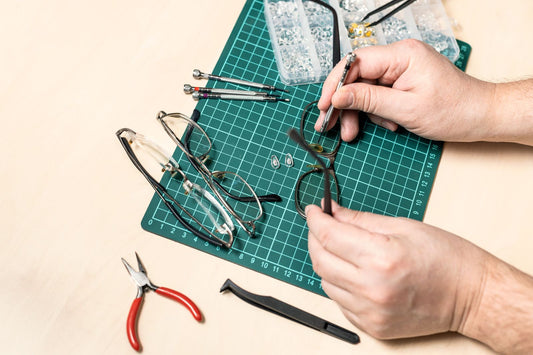
A frame adjustment is a quick job for an optician. Plastic frames are gently warmed so they can be reshaped. Metal frames are adjusted with special pliers. Common adjustments include:
- Straightening the frame so it sits level.
- Moving nose pads to change height and spread the weight.
- Reshaping the bend behind the ears.
- Tightening loose hinge screws.
- Adjusting the tilt of the front (called pantoscopic tilt) so lenses sit at the right angle.
Avoid bending your glasses at home. Plastic can crack and metal can snap. If something feels wrong, read what glasses repairs can be fixed and bring them in.
Fit for sunglasses and kids
Sunglasses should fit the same way, but they often sit a little closer to the face and may wrap around to block side light. Children's glasses need extra attention, because kids grow and play hard. A snug but gentle fit, flexible materials and regular checks make a big difference. See eyewear for kids for more.
Keeping a good fit
Frames loosen over time, especially if you take them off with one hand or push them onto your head. Use both hands, keep them in a case and clean them gently. Our guides on how to store and carry glasses and how to clean glasses properly have more tips.
If your glasses fit well but your vision still seems blurry or you get eye strain or headaches, see an optometrist. These can have many causes, and an eye test is the right place to start. The Healthify website has general NZ health information.
Key terms
- Adjustment
- Reshaping a frame so it sits correctly and comfortably.
- Pantoscopic tilt
- The forward angle of the lenses compared with your face.
- Temple bend
- The curve in the arm that sits behind your ear.
- Optical centre
- The point in a lens that should line up with your pupil.
Frequently asked questions
Should my glasses touch my cheeks?
No. If the frame rests on your cheeks, it may be too large or sitting too low. Nose pad adjustments can often lift it.
Why do my glasses keep slipping down?
Usually the arms are loose or the bridge is too wide. An adjustment often fixes it.
How often should I have my glasses adjusted?
Whenever they feel different. Many people find a check every few months keeps them comfortable.
Can you adjust glasses bought elsewhere?
Usually, yes. Bring them into our Panmure store and we will take a look.
Glasses not sitting right? Visit our Panmure store, open 7 days, for an adjustment, or see our services and glasses repair pages.
Tags:
Previous
How to Read Your Glasses Prescription: SPH, CYL, AXIS and ADD
Next
Full-Rim vs Semi-Rimless vs Rimless Glasses: What to Choose