When to Update Your Glasses Prescription: Signs to Watch
It is time to update your glasses prescription when your vision changes, when your glasses no longer feel comfortable for everyday tasks, or when your optometrist recommends a check. Changes are often gradual, so many people do not notice until things are noticeably blurry. Regular eye tests catch changes earlier.
Quick answer: Watch for blur, squinting, headaches or tired eyes, and follow the check-up interval your optometrist suggests. Once you have a new prescription, you can often have new lenses fitted into your existing frame.
Common signs your prescription may have changed
Your eyes can change slowly over months or years. These are some of the most common signs people notice:
- Blurry vision at distance, close up or both, even while wearing your glasses
- Squinting to read signs, screens or menus
- Holding things further away to read them, which is common from around your 40s
- Headaches or tired eyes after reading, driving or screen work
- Taking your glasses off to see close up more clearly
- Difficulty driving at night or more trouble with glare than before
These signs do not always mean a new prescription is needed. Tired eyes can also come from long screen sessions, poor lighting or dry eyes. Our guide to digital eye strain and the 20-20-20 rule covers that side of things.
When to get help quickly
Some symptoms are not a prescription issue and need prompt attention. If you notice sudden vision loss, flashes of light, a shower of new floaters, a curtain over part of your vision, eye pain or double vision that comes on suddenly, see an optometrist or doctor straight away.
How often should you get your eyes checked?
There is no single rule that suits everyone. How often you need an eye test depends on your age, your eye health, your family history and any conditions such as diabetes. The safest guide is the recall interval your optometrist gives you.
| Situation | General guide |
|---|---|
| Children and teens | Regular checks as advised, as eyes change quickly while growing |
| Adults with no known issues | Every couple of years is common, or as your optometrist advises |
| Adults over 40 | Often more frequent, as near vision changes and eye health checks become more important |
| People with diabetes or eye conditions | Follow your optometrist's or doctor's schedule closely |
This table is general information only. We are not optometrists and do not do eye tests, so please book with an optometrist for an eye examination. Healthify has NZ-specific information on eye health and vision checks.
Why prescriptions change
Several things can shift your prescription over time:
- Growth. Children's eyes change as they grow, which is why kids' eyewear often needs updating more often.
- Presbyopia. From around your 40s, the lens inside the eye becomes less flexible. Close focus gets harder and you may need reading glasses or progressive lenses.
- General health. Some health conditions and medications can affect vision.
- Natural ageing. Small changes are a normal part of getting older.
What happens after you get a new prescription
Once your optometrist gives you a new prescription, you have a few options. It helps to know how to read your prescription so you can see what has changed.
- New lenses in your existing frame. If you love your current frame and it is in good condition, new lenses can often be fitted into it. This is called reglazing or a prescription update.
- A new frame and lenses. A good option if your frame is worn, loose or no longer your style.
- A second pair. Many people add prescription sunglasses or a dedicated computer pair at the same time.
Can my existing frame be reused?
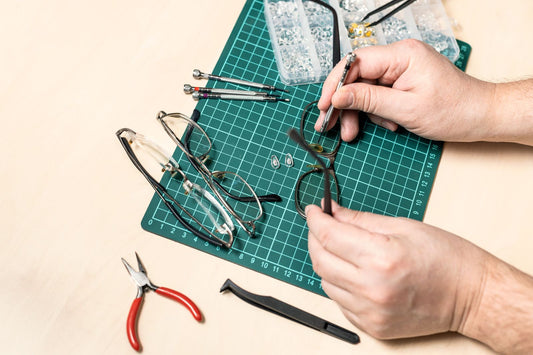
Often yes, but not always. We check that the frame is sturdy, the hinges and screws are sound, and the frame shape suits the new lenses. Very old or brittle frames may not survive the process, and some rimless designs need extra care. Our article on glasses repairs explains what we look for.
If your prescription has become stronger, it is also worth thinking about lens material. Higher prescriptions can look thick in standard lenses. Our guide to lens materials and thickness explains the options.
Tips for adjusting to a new prescription
New lenses can feel strange for a few days. That is normal. Your brain is getting used to the change.
- Wear your new glasses consistently rather than swapping back and forth.
- Expect slight differences in how floors or edges look at first, especially with progressives.
- Make sure the frame is adjusted to sit properly. A poor fit can feel like a prescription problem. See how glasses should fit.
- If things still feel wrong after a week or two, contact us and your optometrist so the prescription and the lenses can both be checked.
Key terms
- Prescription
- The written result of your eye test that tells the lens maker what lens power you need.
- Recall interval
- How long your optometrist suggests waiting before your next eye test.
- Presbyopia
- The natural, age-related loss of close focusing ability, usually noticed from the 40s.
- Reglazing
- Fitting new lenses into an existing frame.
Frequently asked questions
How long is a glasses prescription valid?
It depends on your optometrist's advice and your circumstances. If your prescription is a few years old, or your vision has changed, it is worth having a new eye test before ordering lenses.
Can I use my old frame with a new prescription?
Often yes, if the frame is in good condition and suits the new lenses. Bring it into our Panmure store and we can check it for you.
Do you do eye tests?
No. We are not optometrists. Please book an eye test with an optometrist, then bring your prescription to us for frames and lenses.
Will my glasses be ready the same day?
Some glasses can be ready the same day, depending on your prescription and what lenses we have in stock. Ask us when you visit.
Got a new prescription? Bring your frame into our Panmure store for a prescription update or reglazing, or browse our glasses if you are ready for a fresh look.
Tags:
Previous
What Is Pupillary Distance (PD) and Why Does It Matter?
Next
What Is Pupillary Distance (PD) and Why Does It Matter?